For any multi-family Addison property beyond a duplex, the water heater strategy question comes up eventually — usually when the original heaters start failing.
Two paths, real tradeoffs.
Unit-by-unit tank heaters
Each unit has its own 40- or 50-gallon tank. Standard in most 1970s–90s Addison multifamily construction.
Pros:
- Each unit meters and pays for its own hot water
- Failure of one unit's heater affects only that unit
- Simple retrofit / replacement
- No large mechanical room needed
Cons:
- Many failure points to manage
- Each unit needs T&P testing, expansion tanks, code compliance
- 40-year-old buildings have tanks in every unit failing on staggered schedules
- Aggregate replacement cost over 10 years is high
- Lower efficiency per gallon than central systems
Central boiler / high-efficiency commercial systems
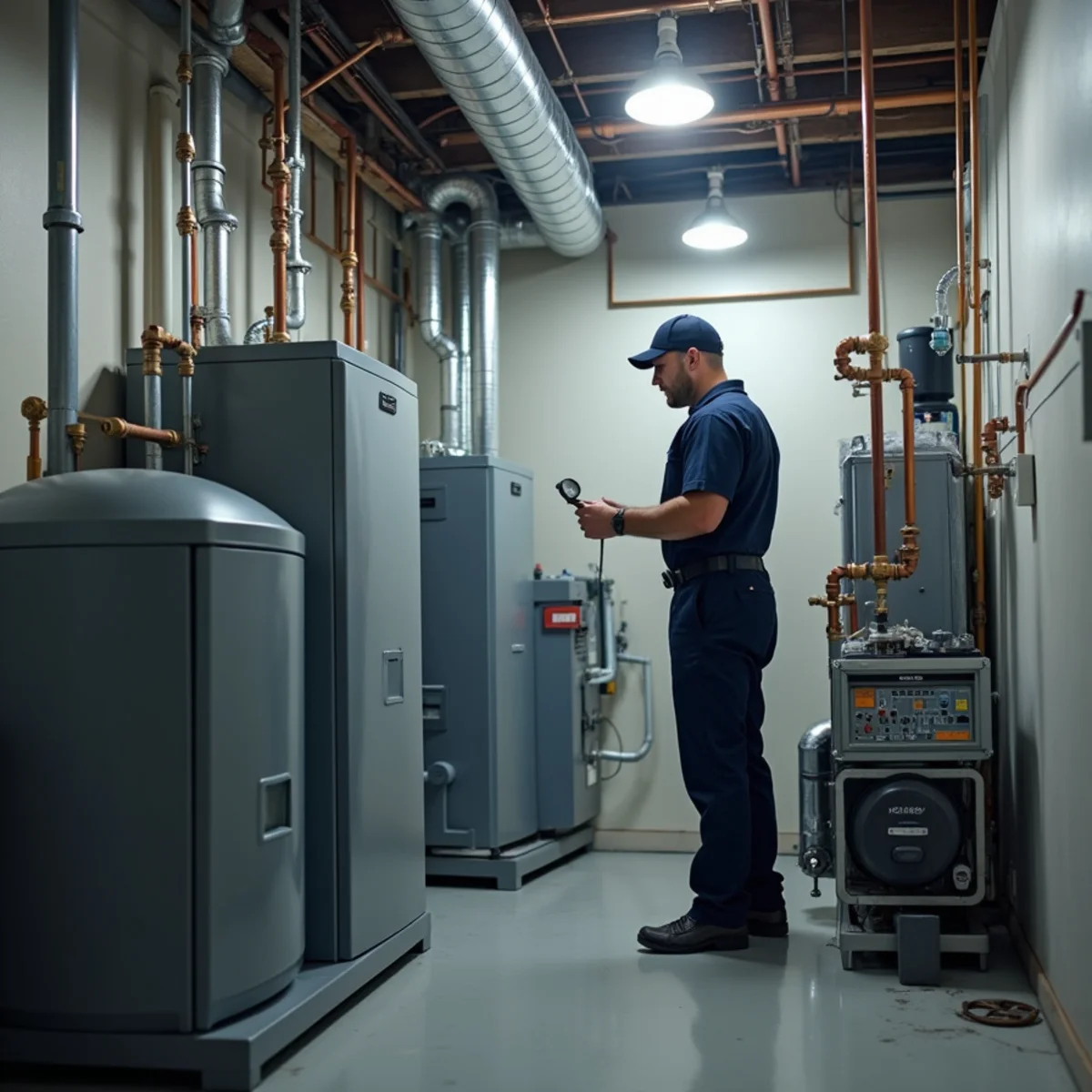
One or two large commercial boilers (or a bank of them) serving hot water to every unit via a recirculating loop.
Pros:
- Fewer failure points, easier to maintain
- Higher efficiency (condensing boiler tech)
- Uniform pressure and temperature across units
- Building owner controls the equipment
- Better data on usage (submeter each unit)
Cons:
- Central failure = entire building loss
- Requires mechanical room and dedicated venting
- Recirculating loop needs periodic descaling and pump replacement
- Higher up-front cost
- If owner pays hot water in the lease, no per-unit incentive to conserve
Hybrid: central + tankless in-unit
Some newer Addison developments do a hybrid — central preheat with in-unit tankless boosters. Best of both, most complex to install.
The right answer for Addison-specific buildings
1970s–80s townhome-style multifamily (small footprint, few units): Stick with unit-by-unit. Replace tanks proactively on a 12-year cycle.
1990s–2000s garden-style apartments (larger, mechanical rooms exist): Central boiler makes sense on major overhaul. Otherwise unit-by-unit.
High-rise condos (dense, per-unit ownership): Central systems dominate. Individual condos may have supplemental tankless.
Mixed-use (retail below, residential above): Central boiler with recirculating loop — the retail side often demands high commercial output that unit-by-unit cannot provide.
The cost-of-ownership math
For a typical 100-unit Addison multifamily, over a 20-year horizon:
- Unit-by-unit tanks: 2x replacement cycles per unit + individual T&P / expansion tank / pan work — significant aggregate cost
- Central condensing boiler: One major install + preventive maintenance + one probable major overhaul
The central-boiler path usually wins on a 20-year TCO for buildings 50+ units. Below that, unit-by-unit wins on simplicity.
Hard water — same issue either way
Dallas hard water attacks both systems. Central boilers scale up faster than most owners plan for; unit-by-unit tanks scale at the same rate but with less catastrophic failure risk. Softening the incoming water at the building level solves it for both.
When to reevaluate
- Water heaters are failing on batch schedules across units
- Central boiler is at 15+ years and needs major service
- Building major renovation planned
- New submetering / billing rules make per-unit measurement worth it
Our commercial plumbing team has installed and serviced both configurations across Addison multifamily. We do free cost-of-ownership consultations for property managers evaluating the switch.
Belt Line Plumbing expert insight
This guide reflects what our licensed Texas RMP plumbers see on real commercial calls across Addison, Farmers Branch, Carrollton, and the greater Dallas North Tollway corridor. Belt Line Plumbing Co. has served the Addison area since 2007, with 412+ five-star reviews from north Dallas homeowners, property managers, and Belt Line Restaurant Row operators.
Local factors that affect the advice above: North Texas expansive clay soil drives most residential slab and sewer failures; Dallas Water Utilities supply water at 8–11 grains of hardness per gallon shortens every water heater and tankless system without a softener; and the February 2021 Winter Storm Uri freeze exposed attic supply lines across almost every 1970s–2000s Addison home. If your situation includes any of these local realities, factor them in before deciding between repair, replacement, or a preventive upgrade.